Nutrient Absorption Curve: How to Know If Your Crop Is Getting What It Needs
May is a critical month for crops such as vineyards and olive groves. Flowering represents one of the phases of greatest physiological demand in the cycle, and any nutritional imbalance at this time can directly affect production and the quality of the harvest.
The problem is that, often, when the symptoms become visible in the field, it is already too late to correct the essentials.
This is where the analysis of the nutrient absorption curve becomes an indispensable tool.
Each culture is unique.
The strategy must be too.
Our agronomists will work with you to develop strategies tailored to the needs
of your farm.
What is the nutrient absorption curve
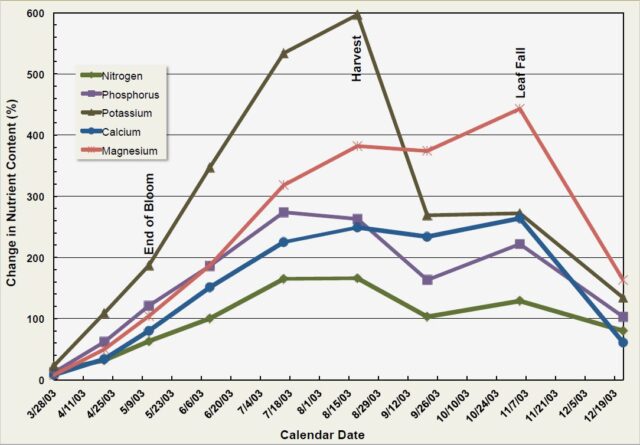
The absorption curve represents the evolution of the plant's nutritional needs throughout the crop cycle. In practice, it allows us to understand which nutrients are most important at each stage and when the plant experiences the greatest physiological demand.
More than just defining quantities, this tool helps to align nutrition with the actual rhythm of the crop. In vineyards and olive groves, the needs change significantly between bud break, flowering, fruit set, and fruit filling. Fertilizing always in the same way, regardless of the phase, often means losing efficiency and increasing costs.
Knowing this curve allows to stop a fixed calendar fertilization and starting to fertilize based on what the crop actually needs.
Applying fertilizer does not guarantee absorption
This is one of the most common mistakes in nutritional management.
The fact that a nutrient is applied does not automatically mean that it is available to the plant, nor that it is being correctly absorbed or metabolized. Nutritional efficiency depends on several factors: soil availability, the balance between nutrients, root activity, the quality of irrigation water, and the physiological capacity of the plant.
In many cases, the problem is not the lack of fertilization. It is the plant's inability to utilize what already exists in the system.
That's why fertilization should always start with diagnosis.
Soil and water: understanding the starting point
Before defining any nutritional plan, it is essential to understand the reality of the farm.
The soil analysis allows for the evaluation of available nutrients, pH, salinity, organic matter, and cation exchange capacity.
The analysis of the irrigation water shows which elements are entering the operation throughout the cycle and may be altering the nutritional balance without this being immediately noticeable in the field.
When these analyses are cross-referenced with the absorption curve, it becomes possible to adjust fertilization more efficiently and avoid unnecessary applications.
Relationships between nutrients: when excess leads to deficiencies
Not all nutritional imbalances arise from a lack of nutrients. Often, the problem lies in the excess of certain elements, which end up blocking the absorption of others.
A classic example occurs in vineyards: high levels of potassium can hinder the absorption of magnesium. Magnesium may be present in the soil - and may even have been applied - but the plant is unable to utilize it properly.
The impact arises later: difficulties in maturation, lower physiological balance, and problems with grape quality.
Understanding these relationships before fertilizing makes all the difference between an efficient plan and a waste of resources.
Sap analysis: understanding what the plant is really absorbing
Sap analysis allows for the evaluation, in almost real-time, of the nutritional status of the crop.
While soil analysis shows the potential availability of nutrients, sap analysis shows what the plant is actually absorbing and metabolizing at that moment. This allows for the identification of imbalances before visible symptoms, anticipating deficiencies, and quickly adjusting the nutritional strategy.
It is a particularly useful tool in critical phases such as flowering and fruit set, where reaction time makes a difference.
Transforming data into agronomic decisions
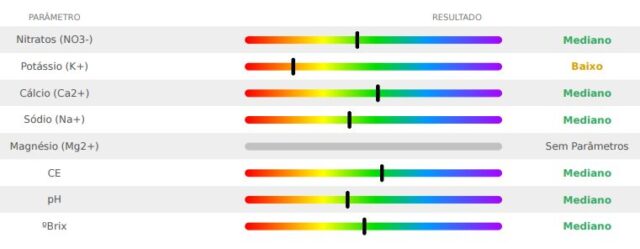
When the analysis data is integrated into tools like Fieldwork (powered by Wisecrop), it becomes possible to graphically visualize the relationships between nutrients and quickly interpret potential imbalances.
Relationships such as K⁺/Ca²⁺, Ca²⁺/Na⁺, or K⁺/Mg²⁺ allow for anticipating limitations before they become visible problems in the field.
This ability to anticipate is today one of the main advantages of precision agriculture applied to nutrition.
Nutrition isn't about a schedule; it's about monitoring
The absorption curve shows what the plant needs.
The soil and water analyses show what is available.
The sap analysis shows what is really happening inside the plant.
Bringing these three dimensions together is what allows us to make decisions tailored to the realities of the field, rather than following set routines.
Efficient fertilization depends, above all, on the ability to interpret what is happening in the crop.
Learn more about our Agronomic Technical Advisory
Contact us
Do you have a question or need support for your crop? Send us your request and we will get in touch.