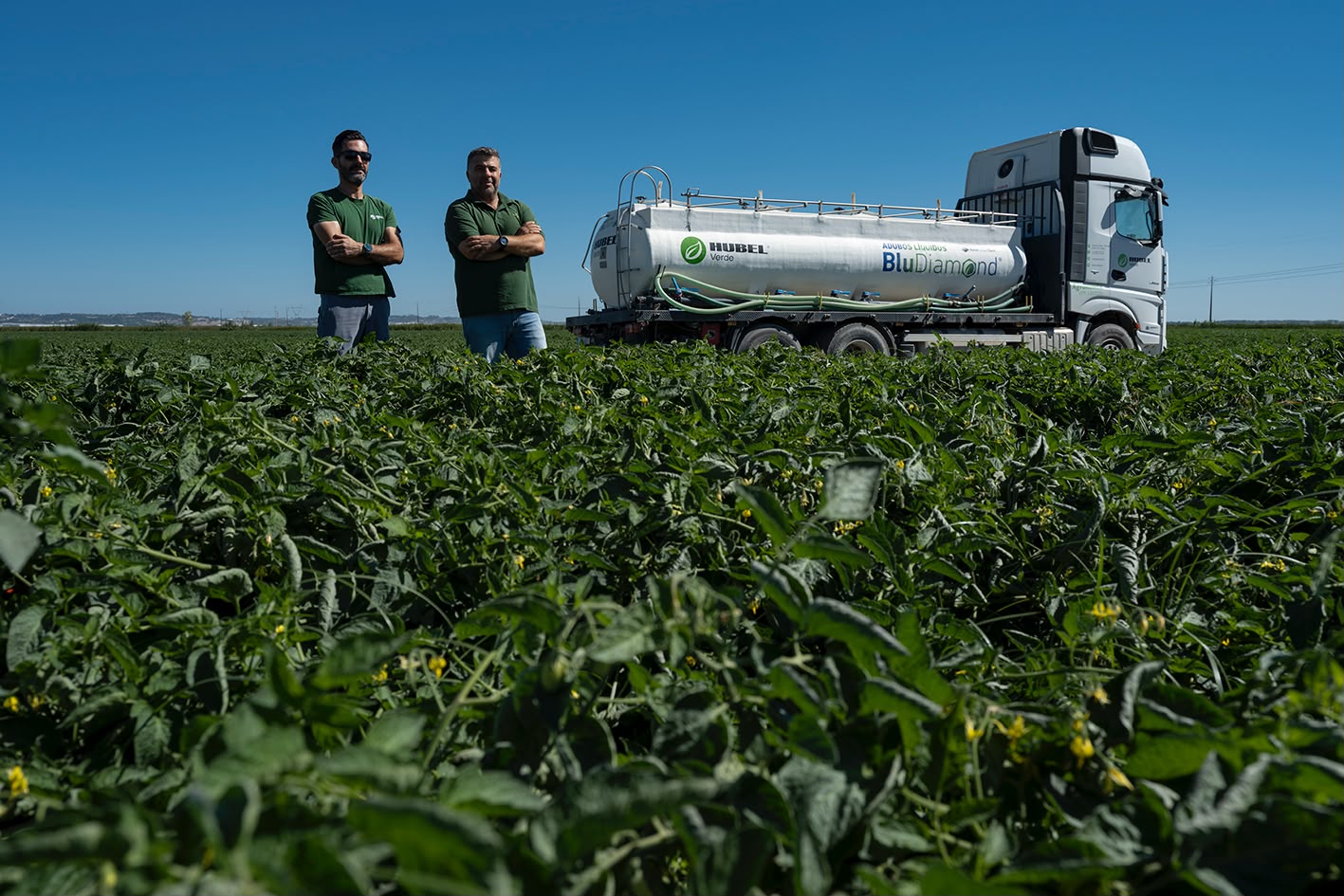
Plant extracts in crop protection: how to intervene without halting production
Technical Recommendation for May
 Pedro Rosa, technical and sales consultant at Hubel Verde in the Algarve region, signs the Recommendation by Hubel Verde for May, dedicated to the use of plant extracts as a complementary tool in the protection of crops, especially during phases when intervention becomes more sensitive.
With the heat of May, the pressure from pests intensifies. Aphids, mites, thrips, and whiteflies appear when the crop is in full production and the harvest cannot stop.
It is precisely in this context that many conventional solutions are no longer viable: safety intervals that do not align, restrictions on use, or reduced efficacy in populations that are difficult to control.
Plant extracts emerge as a complementary tool for these situations. They do not replace all available solutions, but they have a clear role at specific moments in the campaign.
Each crop is unique.
The strategy must be too.
Our agronomists will work with you to develop strategies tailored to the needs
of your farm.
Take action at the right time, without halting production
Throughout the campaign, it is common for pests such as aphids, mites, or whiteflies to emerge. The challenge lies not only in their presence but in the context in which they appear.
“In crops currently being grown, we often don’t have the leeway to use certain solutions. During the harvest phase, we need to use residue-free products so as not to compromise the quality of the fruit, the environment, or consumer health”, says Pedro Rosa.
In crops such as raspberries, blackberries, or strawberries, where harvesting takes place daily or nearly daily, this limitation becomes critical. In these cases, protection must be continuous and compatible with field operations.
Plant extracts as a complementary tool
Plant extracts have been gaining importance in this context. Derived from different parts of plants, they can:
- Act at the level of plant protection;
- Support plant physiology;
- Contribute to the overall balance of the crop.
But rather than replacing conventional solutions, they serve as a technical complement, allowing for greater flexibility in the management of the culture.
Control of insects in sensitive stages
In situations involving insect pressure, the approach involves consistently reducing that pressure without disrupting field operations.
Strongbal Mix acts as a repellent and interferes with the pest cycle, making it difficult for eggs to hatch and for reproduction.
When combined with Kisetum K (Equisetum arvense L.), that acts by contact, the control becomes more effective, especially against pests such as aphids, mites, thrips, scale insects, or whiteflies.
In addition, this combination helps reduce honeydew and sooty mold, improving the crop's health.
|
|


Adjust the strategy throughout the cycle
None of these solutions should be viewed in isolation. What makes the difference is integrating them into a strategy tailored to the crop cycle, the timing of application, and the actual field conditions.
These solutions are compatible with integrated and organic production, with no harvest restrictions, and have modes of action that differ from those of conventional products, making them useful even in situations where pest pressure is high or control is difficult.
“These solutions give us room to adapt the strategy to what is happening in the field, without creating blockages”, mentions Pedro Rosa.
Make decisions based on the reality of the field
Crop protection should not be viewed as a series of isolated applications, but rather as a strategy that is adjusted throughout the crop cycle. In the case of plant extracts, their value lies in their ability to complement other solutions and enable a more flexible approach.
Observing, adjusting, and intervening at the right moment remains the foundation of effective protection.
If you wish to understand how these solutions can be integrated in your crop, talk with us. The team at Hubel Verde is in the field and available to assist.
Contact us
Do you have a question or need support for your crop? Send us your request and we will get in touch.