What is Assisted Pollination?
Assisted Pollination is a technical solution that complements natural
pollination, promoting more effective
fertilization and better fruit set,
especially in crops such as avocado,
kiwi, almond trees, and small fruits.
Each crop is unique.
The strategy must be as well.
Our agronomists will work with you to develop strategies tailored to the needs
of your farm.
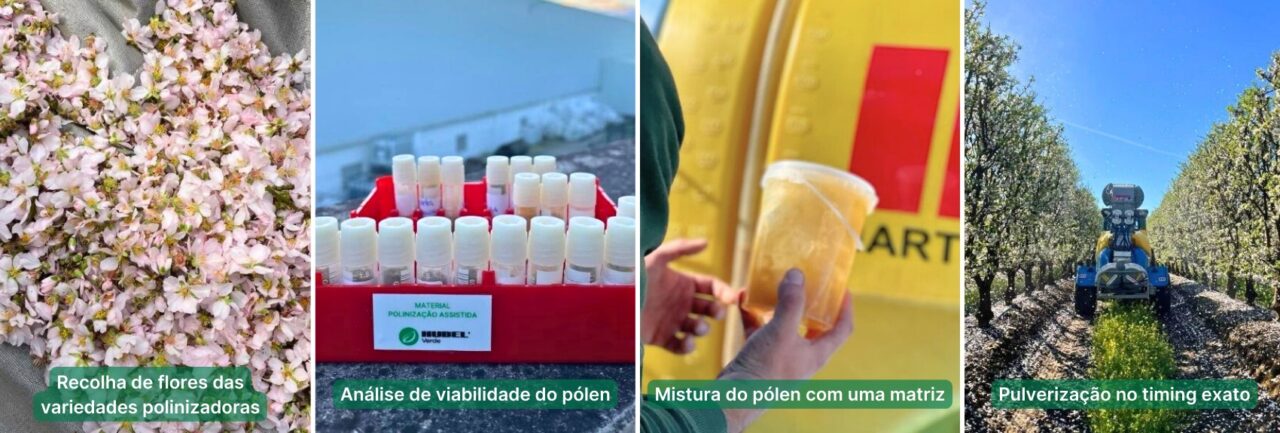
Step by step process
Methodology
The present demonstration was conducted in an almond orchard established in 2017, with the Belona variety.
The objective was to evaluate the influence of assisted pollination, using an electrostatic technology nebulizer, on fruit load, fruit quality, and productivity of the three varieties.
The trial took place in Figueira dos Cavaleiros, in an orchard with a drip irrigation system and a density of 416 plants/ha. Treated plots and control plots were defined, keeping the remaining cultural practices the same in both modalities.
On March 16 and 21, 2023, two applications of assisted pollination of pollen, previously collected, were carried out with an electrostatic technology nebulizer and a flow rate of 100 L/ha. Three applications were initially planned, adjusted to the evolution of flowering, but only two could be performed due to high temperatures and the absence of receptive flowers.
Throughout the trial, visual records, estimates of fruit load, and analyses of fruit quality were made. The production of the treated and control plots was evaluated by the producer at the time of harvest, conducted between August and early September 2023.
Results
Throughout the cycle, no significant visual differences were observed between the treated and untreated plots.
At harvest, 300 fruits were sampled per modality, in three repetitions.
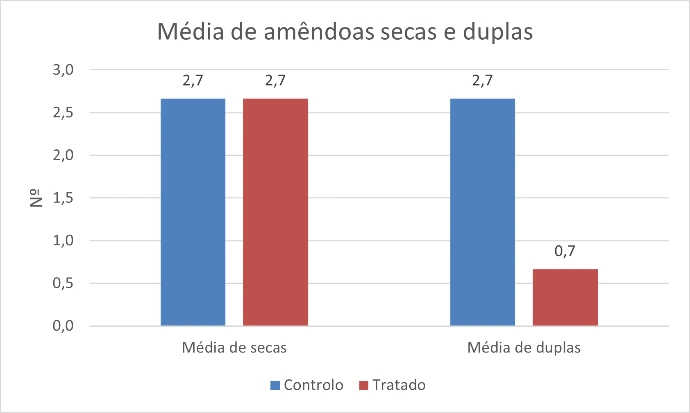
In the treated plot, the average kernel weight was 124.7 g, compared to 110.3 g in the control, which represents an increase of 13%. A lower number of double almonds was also recorded.
According to the producer, the production reached 820 kg/ha in the treated plot, compared to 619 kg/ha in the control plot, which corresponds to a increase of 32.4%.
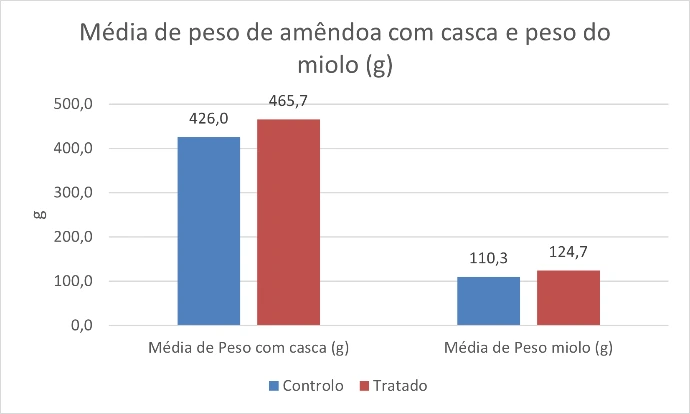
Variety Belona; Average weight of the almond with shell and the kernel (g) from both plots (Control and Treated). Sampling of 300 fruits.
Variety Belona; Average of dry and double almonds from both plots (Control and Treated). Sampling of 300 fruits.
Conclusions
Although only two of the three planned applications were carried out, a favorable result was observed in the Belona variety. Repeating the trial in the future, with the complete protocol adjusted to the flowering state and the weather conditions, will confirm the consistency of this result.
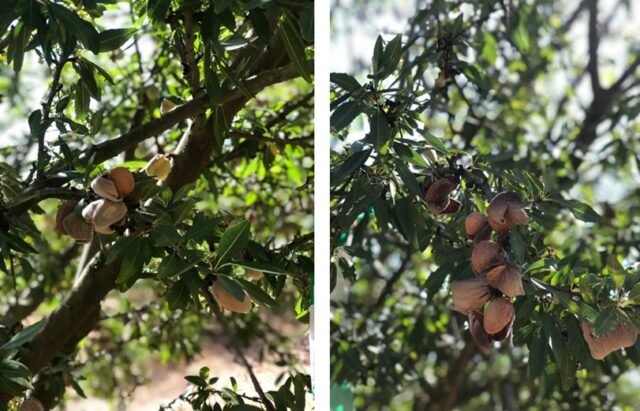
Fruits (var. Bellona) – Before harvest Control on the left and Treated on the right
Producer: Terras S. José de Botas, Lda.
Location: Figueira dos Cavaleiros
Planting Date: 2017
Contact us
Do you have a question or need support for your crop? Send us your request and we will get in touch.