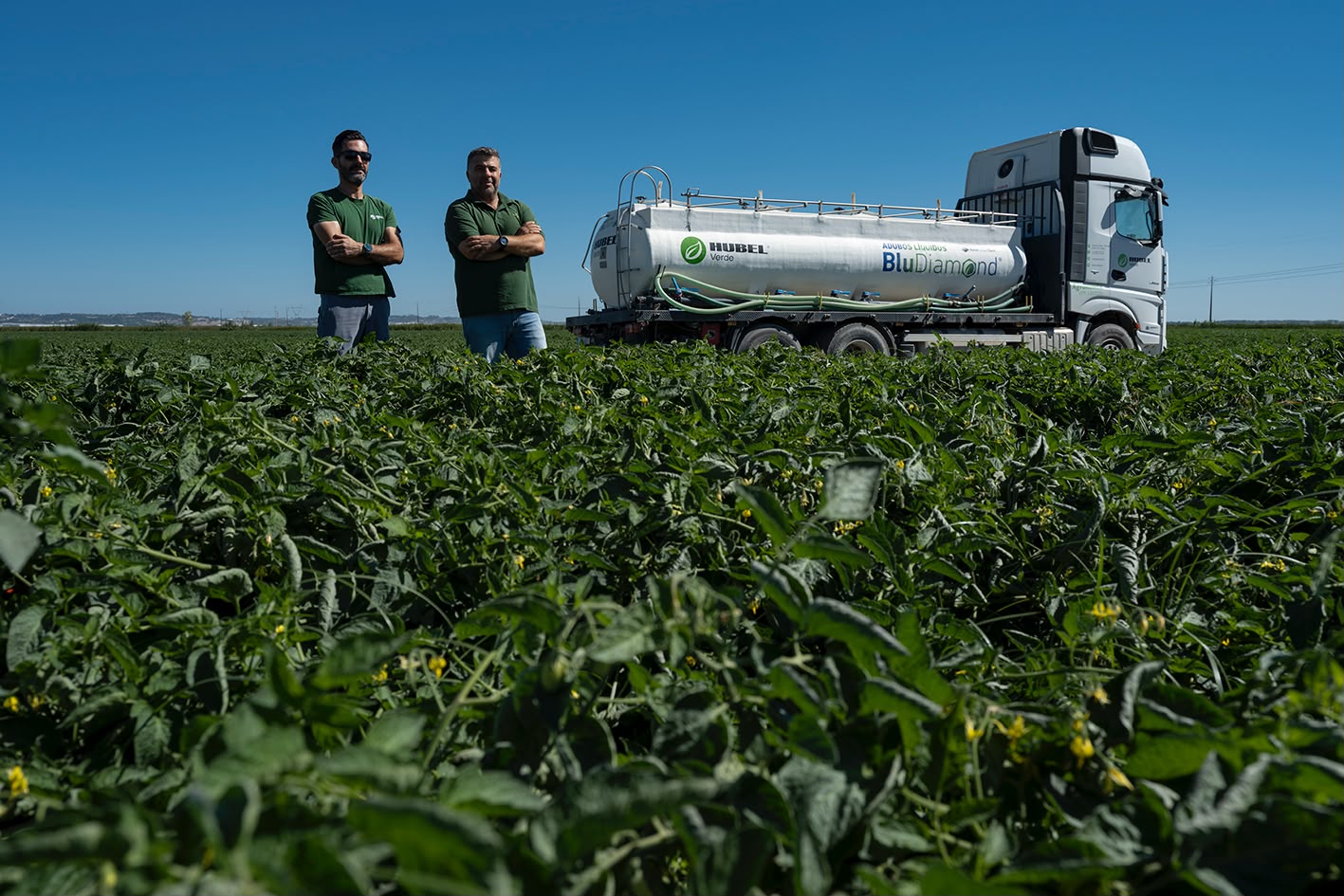
Let's ensure a good start for the Potato
Technical Recommendation for October
Part 1
Potatoes are a demanding crop from the very beginning of their growth cycle. Water management, crop establishment, root development, and nutrient availability lay the foundation for what happens later—tuber formation and tuber filling.
In this first part of Hubel Verde’s October Recommendation, Francisco Barradas, area coordinator for Ribatejo, Oeste, and the Setúbal Peninsula and technical-commercial consultant at Hubel Verde, discusses the decisions that guide the crop from planting through vegetative development.
Want to know how we can assist your farm?
Water first
“No nutritional program can compensate for an inadequate management of water.”
The availability of water should remain as regular as possible throughout the cycle, with special attention to the most sensitive phases.
Irrigation should be adjusted to the type of soil, evapotranspiration, crop status, and tuber development. In areas at risk of salinity, it is also important to monitor the electrical conductivity of the irrigation water.
This information should be considered together with the soil analyses and the expected productivity in defining the fertilization plan.
Seed potato treatment: start with installation
Francisco states that “the first step should be to ensure a good installation of the seed potato, with uniform emergence and rapid root development.”
O Germisem é indicado para o tratamento de sementes e tubérculos, com ação na germinação e no enraizamento. Na batata, a aplicação é feita por impregnação no momento da plantação, em conjunto com BluDiamond Booster, com distribuição uniforme sobre os tubérculos.
The goal at this stage is to create conditions for a homogeneous emergence and an active root system from the start.
Root development: better explore the soil
In the February Hubel Verde Recommendation we addressed the role of the BluDiamond® Solplex Mycotec in the base fertilization of potatoes. In this recommendation, the focus shifts mainly to how this base can be supplemented through the root system.
The MycoUp, inoculant with Glomus iranicum var. tenuihypharum, promotes mycorrhizal symbiosis and increases the soil exploration capacity by the roots, which favors the absorption of water and nutrients.
The use should prioritize the early stages of the crop, when root colonization can have a greater influence on subsequent development.
Rhizosphere and phosphorus: better utilize the available nutrients
The amount of nutrients applied does not determine, by itself, what the plant can utilize. The activity of the rhizosphere and the availability of nutrients in the soil also play an important role.
O MCT Terra, à base de aminoácidos de origem vegetal, pode integrar uma estratégia dirigida ao solo e à rizosfera, com o objetivo de favorecer a interação com organismos benéficos e apoiar o equilíbrio biológico do solo.
O Natiphos é um biofertilizante baseado em microrganismos e metabolitos naturais, associado à solubilização do fósforo e ao desenvolvimento radicular e vegetativo.
Its use can be positioned at a stage where the root development is a priority, with the aim of improving the availability of phosphorus present in the soil and that provided through fertilization.
O VitaSoil, já desenvolvido na recomendação de fevereiro, pode complementar esta abordagem através da atividade microbiológica da rizosfera e da disponibilização de nutrientes.
“A fertilização deve ser baseada em análises de solo e água e ajustada à produtividade esperada”, explica o consultor.
Vegetative development: build a functional leaf area
After installation, the crop needs to develop a sufficient and functional leaf area, capable of sustaining photosynthetic activity and, later, the development of tubers.
Na Recomendação Hubel Verde de fevereiro também abordámos o Utrisha N, baseado em Methylobacterium symbioticum SB23, como complemento da estratégia de fertilização azotada.
At this stage, it is especially important to ensure a balanced vegetative development and a functional leaf surface, without losing sight of the subsequent transition to tuberization.
A good foundation prepares the following phases
From tuberization onwards, priorities change. The management of stress, nutritional balance, and potassium availability gain greater importance as the focus shifts to the development and filling of the tubers.
In the second part of this recommendation, we address
precisely this transition: from tuberization to filling.
If you need support in applying these recommendations in your farm, the Hubel Verde team is available to assist in the field and adjust the strategy to your specific
production context.
Second Part of the Hubel Verde Recommendation
Contact us
Do you have a question or need support for your crop? Send us your request and we will get in touch.